
.png?width=1620&height=1620&name=Img%20(53).png)
.png?width=1023&height=1023&name=Img%20(53).png)
The AI stack is shifting from a “chat” logic to an “action” logic: autonomous agents, integrated commerce, and enterprise-level auditability are converging into a new control plane for work. The common thread is distribution: those who manage to be embedded in the daily workflows (and payments) of billions of users and millions of employees will hold the advantage.
Main news
Meta acquires Manus to accelerate autonomous AI agents
Meta is acquiring Singapore-based agent startup Manus in a deal worth over $2 billion, strengthening Meta’s strategy of moving from assistive AI to agentic systems capable of autonomously executing tasks across its entire product suite. Reports also highlight the attention paid to Manus’s Chinese origins: an early signal that, in the future, agentic capabilities and provenance governance will be evaluated together in negotiations. (The Wall Street Journal)
Google adds in-chat checkout to Gemini, closing the “assistant-to-transaction” gap
Google has announced expanded shopping features in Gemini, including an instant checkout that allows users to purchase directly within the chat via supported payment providers. Gemini is thus positioning itself as a conversion channel, not just a discovery tool. This explicitly mirrors OpenAI’s direction with Instant Checkout (powered by Stripe) and transforms “AI answers” into measurable GMV. (AP News)
Apple partners with Google: Gemini becomes the foundation for Siri’s next-gen models
Apple and Google have confirmed a multi-year collaboration under which the next generation of Apple Foundation Models will be based on Gemini models and Google cloud technology, with the goal of powering future Apple Intelligence features, including a more personalized Siri. Reports indicate that Apple evaluated other model providers before choosing Google, while maintaining emphasis on Apple-controlled environments for privacy. (blog.google)
Why Apple didn’t choose OpenAI for the “core Siri” layer: the simplest explanation is control and supply-chain risk. Apple already uses OpenAI for “complex queries,” but the assistant’s core architecture requires multi-year commercial terms, predictable capacity, and a vendor posture that Apple can operationalize at iPhone scale — Google can offer an integrated model+cloud package, while Apple retains leverage by keeping the deal non-exclusive. (Strategic irony: Google gains privileged distribution on Apple’s install base.)
Allianz partners with Anthropic: regulated enterprise agents with auditability as a feature
Allianz and Anthropic have announced a global partnership to deploy Claude on Allianz’s internal AI platform and build custom agentic systems to automate insurance workflows, including claims-related processes, integrated with systems that record decisions, rationales, and data sources for traceability and regulatory compliance. This represents the clearest pattern of “agent rollout in a regulated industry”: value creation with an auditable record. (Allianz.com)
Benchmark that changes executive behavior: delegation becomes the default
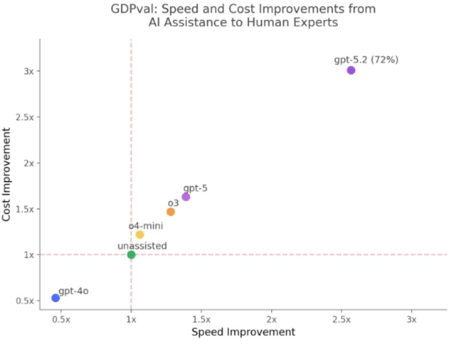
Ethan Mollick highlighted benchmark results (GDPval framing) suggesting a jump from ~39% to ~72% in outcomes matching or exceeding those of human experts on drafting tasks for GPT-5.2-class models. The operational implication is not marginal productivity, but a workflow redesign: if success rates exceed a threshold, leaders stop treating AI as “draft support” and begin treating review and oversight as the central managerial task. (oneusefulthing.org)
What really matters here is the percentage of times AI produces work at least as valid as that of a human expert on the first attempt. GPT5 matched human experts 39% of the time, while GPT5.2 sits at around 72%.
Conclusions
The market is evaluating three capabilities as a single package, recognizing their interdependence and strategic impact:
- Agent autonomy, meaning the ability of systems to execute tasks independently and make operational decisions without direct human intervention;
- Large-scale distribution, which enables these capabilities to be applied consistently across multiple products, processes, and contexts, multiplying their effectiveness;
- Traceability governance, essential for ensuring transparency, auditability, and regulatory compliance across all activities delegated to intelligent systems.
The winners of 2026 will not simply be those who possess the most advanced models. They will instead be those capable of controlling the operational surfaces where work is delegated, monitoring completed purchases, and ensuring that all decisions are traceable and subject to audit. In practice, the true competitive advantage does not stem only from model power, but from the ability to orchestrate autonomy, scalability, and governance in an integrated manner.